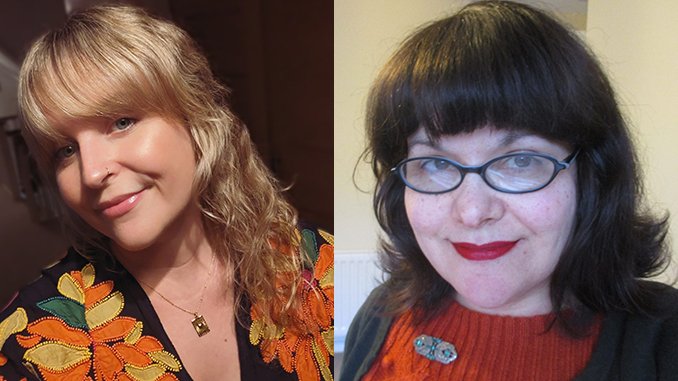
In this interview for BookBlast Diary, Charlie Coombe and Tina Kover talk language, literature, inspiration, success and more with Georgia de Chamberet.
Tell us a little bit about yourself.
Charlie Coombe (CC): I have been a translator for eighteen years, and a literary translator for about fourteen of those. I am a full-time paid house and pet sitter, so most of the time I am living in other people’s houses, pretending their pets are my pets. With any other time I have, I take trips to places like Barcelona or Sicily, or I stay with friends and family. I am a bit of a nomad and this has its challenges when it comes to sitting down and getting translation work done. But it also means I haven’t paid rent or bills since 2018.
Tina Kover (TK): I started doing commercial translation right out of university in 1997, and moved into literary translation (self-publishing at first) in 2004. I grew up in Denver, Colorado, but from the age of twenty-five I bounced around the world, living in Switzerland and the Czech Republic for years at a time with stints back in Denver in-between, before settling permanently (perhaps) in England in 2010. I’ve got a gorgeous husband and two incredibly spoiled cats, and I feel lucky every single day.
When you were growing up, what books had an impact on you?
Charlie Coombe (CC): I have always had a penchant for fiction that tries to get to the core of understanding the human condition, what makes us do the things we do, and what makes us the way we are. I loved any books or writers who really did that well. Margaret Atwood’s short stories and novels had a huge impact on me in my teenage years. Studying The Handmaid’s Tale for A-level English Literature was a real turning point for me, when I really started to understand how powerful prose can truly be. She is a master of imagery, of a beautifully constructed sentence, and I was blown away by it.
Tina Kover (TK): I could read by age three, believe it or not, and I’ve been a broad and voracious reader ever since. My first favourites were Laura Ingalls Wilder, L. Frank Baum, and Louisa May Alcott, and I have always loved reading history and non-fiction. What I love most of all is a perfectly crafted sentence. When words make you ache with their beauty. My all-time favourite writer is Raymond Chandler – a great master of that aching loveliness.
How did your career as a translator come about?
Charlie Coombe (CC): It was forged by nearly two decades of sheer determination, haha! I knew I wanted to be a translator from about my second year of university onwards. It was the element of my languages degree that I loved the most. So after doing some translation internships in Spain and France during my year abroad, when I left uni in 2007 I immediately applied to over 500 translation companies for an in-house job. I did revision in-house for a translation company for a year, then decided to go self-employed and try to make a living from translating. Within a few years (and studying for the IoL DipTrans qualification) I established a decent-enough base of clients for translation and proofreading, to make a living. Then I set about trying to find my way into the world of literary translation, something I knew I always wanted to do. I attended the London Book Fair a couple of times, networked like hell, and chased books, pitched books, put my name in the ring for projects, and so on. I finally got my first couple of opportunities to work with publishers. It has been a long continual process of trying to get books to translate, pitching, doing samples, building my online presence and portfolio. I just kept on contacting publishers, agents, and authors, and trying to find ways to work with them. For the last eight years or so, I have been averaging about a book or two per year, but always relying on other sources of income to keep enabling me to do the literary translation (including being a fulltime house/pet-sitter so I have minimal outgoings). I am now at a point where I am actually translating a few books at once – for the first time in my eighteen-year career, so I feel like all the hard work is finally paying off. It’s a fickle industry, however, very much ‘bust and boom’. You never know when you’re going to have a dry spell!
Tina Kover (TK): It’s quite a random story, really. As I said, my first book in translation (George Sand’s The Black City) was self-published; I translated it just to see how I’d like doing it, really. But once I had the book in my hands I decided to see if I could get it published for “real”, which led to my acquiring an agent and my first literary contract, with The Black City eventually being published by Carroll & Graf. After that, mostly through word of mouth, I ended up in contact with a brilliant editor at Modern Library and got the dream job of translating the early Alexandre Dumas novel Georges, which was published in 2007. From there it was just years and years of hard work and perseverance until my career got a big boost with my shortlisting for the American National Book Award in 2019, for my translation of Négar Djavadi’s Disoriental, published by Europa Editions. Since then I’ve been incredibly busy, doing three or four books a year and also maintaining a part-time “day job” at a British university. It’s a big workload, but I feel so fortunate to be able to do this work that I love so much; I never take it for granted for a moment, and it feels especially meaningful that I’m able to contribute to the fostering of international understanding in the way that translating world literature does, at a time when so many countries seem to be growing less tolerant and more insular by the day.
What are you most proud of translating?
CC: December Breeze by Marvel Moreno, with my stellar co-translator and very good friend, Isabel Adey. That translation was a total labour of love. Moreno’s serpentine prose is the hardest thing I’ve translated in my life thus far, and I am so proud of us for not only finishing it – and not killing each other or ourselves in the process – but also for then having this hard work recognised when we were shortlisted for the Queen Sofia Translation Prize in 2023.
TK: This is a difficult one! In recent years I’d say my proudest achievement was translating Anne Berest’s The Postcard, which is an unforgettable “true” novel, as the author calls it, of her maternal family, which was devastated by the Holocaust, and also of her own evolving identity. It felt like a true gift to be entrusted with this sad and beautiful story, which was also so deeply personal to Anne herself, and it was extremely gratifying to see the book’s success, including its shortlistings for the Dayton Literary Peace Prize in 2024 and the Freudenheim Translation Prize in 2026.
How important is the relationship between author and translator?
CC: It depends. On their level of English. On how big their ego is and how precious they are over their book. On how much they trust the translator. And on whether they are still alive! With a couple of exceptions, I’ve mostly been very lucky to either just be left to do my thing, or I’ve had lovely authors who are happy to answer questions, have discussions and iron out any doubts, but to trust me to make the final translation choices. It is wonderful when you can have a relationship with the author – it can lead to a special bond, as you are bringing their book into English for them.
TK: Just echoing Charlie’s answer – it very much depends, and the relationships can vary greatly. I’ve become friends with a few of my authors, but to be honest, for the most part, I prefer to be left alone with the text during the translation process. Creativity and the production of literature is a deeply personal and private thing, in my opinion, and I like to keep any outside “noise” to an absolute minimum and stay in my own little bubble, just me and the words.
How did Translators Aloud come into being, and what gap did you feel this YouTube channel could fill that wasn’t already covered by journals, conferences and social media conversations?
TK: Translators Aloud was a pandemic baby! During lockdown, I happened to wonder on Twitter (now X) whether anyone might be interested in hearing me read from my own work, and the enthusiasm of the response, from other translators and from people who were fans of translated literature, was overwhelming. Charlie, who I didn’t know personally at the time, though I knew of her work, contacted me via DM and by the end of that day we’d created the channel together. It was obvious from the way translators leaped to contribute, and from the fantastic view counts on the videos we began to post, that this had been a real lacuna in the literary world: a place where the focus was on translators rather than authors, where these creative artists could share their pride in their work, and where readers could put faces to names and show appreciation for the skill and passion of literary translators.
How do you decide who to feature on your channel?
CC: We are not exclusive or selective in the readings we feature. We are open for submissions of translations from any language into or out of English, all year round, and we post pretty much everything we receive, unless there is a compelling reason not to.
TK: We love it all, basically! There are definitely some languages we’d like to spotlight more, particularly translations from the Asian and African languages.

Has hearing other translators read aloud from their work with occasional commentary impacted your views and/or how you translate in practice, and if so, in what way?
CC: Reading my work aloud has always been part of my practice, especially in the final draft stages – it is the best way to check for mistakes, smooth out flow and fine-tune the voice. I think it’s one of the reasons I liked the idea of starting Translators Aloud – because books come to life when they are read aloud.
Five great books in translation which have inspired you, influencing how you read, write and/or think?
CC: Exercises in Style by Raymond Queneau (tr. Barbara Wright); The Stranger/The Outsider by Albert Camus (I read two different translations by Matthew Ward and Joseph Laredo); The Vegetarian by Han Kang (tr. Deborah Smith); All Quiet on the Western Front by Erich Maria Remarque (tr. Arthur Wesley Wheen); and W, or the Memory of Childhood, by Georges Perec (tr. David Bellos).
TK: Essays by Michel de Montaigne (tr. John Florio); One Hundred Years of Solitude by Gabriel García Márquez (tr. Gregory Rabassa); Madame Bovary by Gustave Flaubert (tr. Lydia Davis); Night by Elie Wiesel (both translations, Stella Rodway’s and Marion Wiesel’s); and W.G. Sebald’s Austerlitz (tr. Anthea Bell).
Which book have you translated which illuminated something uncomfortable about yourself?
CC: Marvel Moreno’s December Breeze. During that challenging process, I realised that co-translating is most definitely my preferred way of working, and that some of the best eureka moments and creative solutions to tricky passages can only come about, for me, when I am bouncing ideas off another translator. This concerned me because it made me doubt my own abilities to translate solo ever again. Can I only ‘shine’ when I translate in a team? Co-translation helps to remove the constant self-doubt that I think a lot of us translators suffer from (a result of decision-making fatigue, I always think). So I suppose the uncomfortable thing I learned was that I do tend to doubt my abilities too frequently. But on the flipside, I received validation from my co-translator that I am making some alright choices.
TK: I can’t say I recall any projects that have revealed anything uncomfortable about my own self specifically, but plenty of the books I’ve worked on have roused a lot of anger in me about the eternal (and ongoing) way in which women have been discounted, disregarded, and erased from history. Two recent examples, both of which focus on extraordinary, brilliant, history-making women whose lives and work are all but forgotten today, are the librarian and antiquarian Belle da Costa Greene, whose life is novelized in Alexandra Lapierre’s Belle Greene, and the author, social worker, and women’s rights crusader Stella Miles Franklin, about whom a biographical novel by the same author is forthcoming from Europa Editions in my translation.
What are you working on at the moment?
CC: I am currently working on a few books, actually, so I am pretty busy! I just delivered my translation of The Power of Plankton by Vincent Doumeizel (Legend Press Ltd, May 2026); MILADY by AdélaÏde de Clermont-Tonnerre, a feminist retelling of the story of Milady de Winter (Europa Editions, 2027); Si las cosas fuesen como son, the debut novella from the Uruguayan author Gabriela Escobar Dobrzalovski (HeloÏse Press, 2027); and I am also translating a novel from French for a self-published author.
TK: Right now I’m translating Anne Berest’s latest novel, Finistère, and also editing a very exciting translation into English by my friend and colleague Anya Migdal – a new novel of Jack the Ripper!
Your views on success?
CC: As a translator, the biggest satisfaction you can have is somebody contacting you to tell you how much they loved and appreciated your translation. To me, that is a measure of success. It’s also nice when as the traditionally ‘invisible’ translator, you do receive recognition, awards and reviews, even kind words from a publisher. We work so hard at what we do, and these little nuggets of appreciation make all the bum-ache, back pain, strained eyes, RSI and lack of a social life (somewhat) worth it 
TK: I’d echo much of what Charlie has said. Recognition, awards, a mention of one’s translation in a book review; these are things that translators don’t enjoy often enough, and they mean so much. I feel compelled to add, as well, that higher financial compensation and credit on every translated book cover would be very nice too! At the end of the day, though, to be busy and in demand in a field as small and competitive as literary translation, especially after so many years of hard work, feels like success in itself.
Five favourite prose authors?
CC: Deborah Levy, Margaret Atwood, Claire Keegan, Miranda July, John Fowles.
TK: Off the top of my head: Raymond Chandler, Agatha Christie, Vladimir Nabokov, Jane Austen, Sarah Churchwell.
Five favourite feature films?
CC: Grease 2; Thelma and Louise; Dirty Dancing; Empire Records; Footloose. (As you can see my film taste is incredibly highbrow, ahem, and got stuck somewhere in the ’80s and ’90s). Oh, and an extra one: Frances Ha.
TK: Laura, The Lion in Winter, Back to the Future, Clue, His Girl Friday. I make no apologies for the motley and bizarre nature of this list.
Who are the five people, living or dead, you’d invite to a party?
CC: Ella Fitzgerald; Spike Milligan; Deborah Levy; Dolly Alderton, Leif Vollebekk.
TK: Raymond Chandler and Agatha Christie (again); Simon Callow, Michelle Obama, Hugh Dowding.
Your current bedside reading?
CC: When the Cranes Fly South by Lisa Ridzén, translated by Alice Menzies.
TK: Midnight in Cairo, by Raphael Cormack. Not a translation, but a brilliant study of a little-known slice of women’s history.
Your motto?
CC: Failure is not trying.
TK: Nothing worth having comes easy.